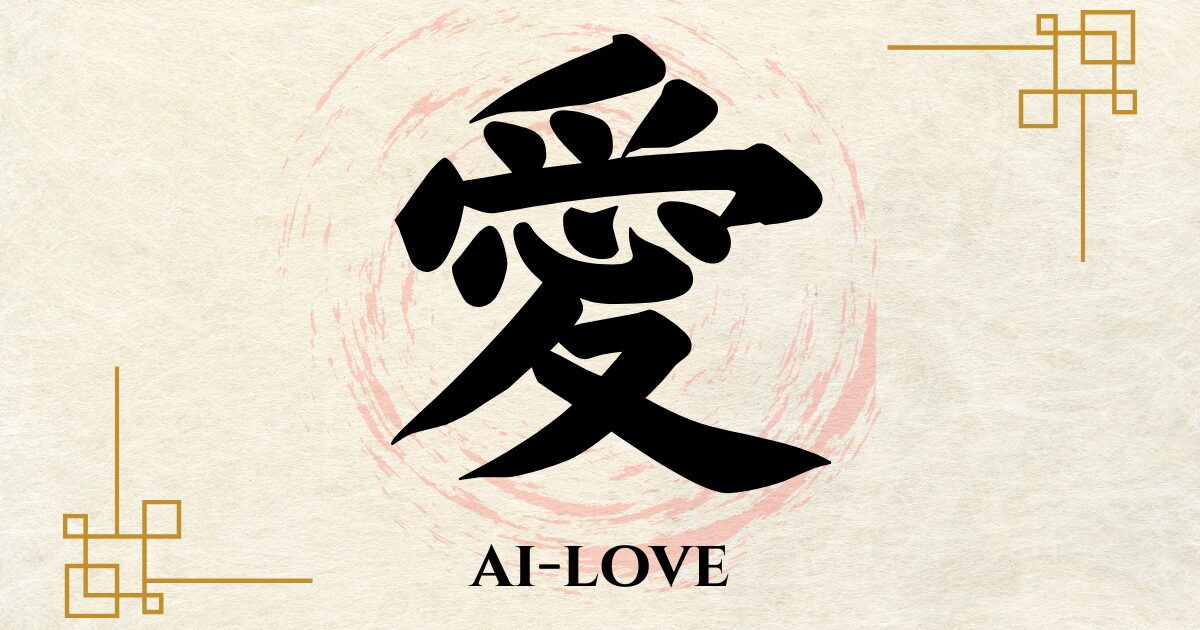
Let’s be real for a second. If you’re an anime fan, you’ve seen this character. You’ve felt the weight of it. It’s not just a word; it’s a whole aesthetic.
We are talking about 【愛】 (Ai).
Most textbooks will boringly tell you “this means love.” Yawn. Forget that. In the world of Japanese culture, manga, and history, Ai is the heavy hitter. It’s the difference between a high school crush and a bond that transcends time and space. It’s the Kanji carved onto foreheads (looking at you, Gaara) and the title of Pillars.
Ready to dive deep? Let’s geek out on why this is the undisputed King (or Queen) of emotional Kanji.
2. Data Box (Quick Stats)
Here is your cheat sheet. Memorize this, and you’ll look like a pro.
| Stat | Details |
| JLPT Level | N3 (Intermediate – The “Mid-Boss” Level) |
| Onyomi (Sound Reading) | AI (Like “Eye”) |
| Kunyomi (Meaning Reading) | ito-shii (いと.しい), mana (まな),Me-deru(め.でる),o-shimu(お.しむ),kana-shii(かな.しい),U-i(う.い) |
| Main Meanings | Love, Affection, Favor |
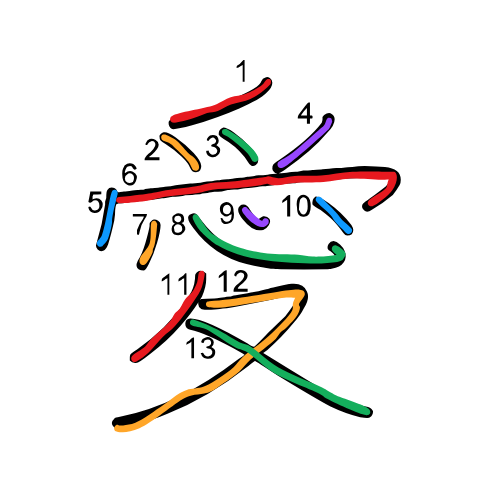
| Stroke Count | 13 Strokes |
| Visual Structure | Top: 爪 (Claw/Hand) Middle: 冖 (Cover) + 心 (Heart) Bottom: 夂 (Winter/Legs dragging) |
3. Introduction
Okay, stop scrolling. Look at the character again: 【愛】.
Does it look simple to you? Absolutely not. It’s dense. It’s complicated. And that is exactly why I love it.
Unlike English, where we “love” pizza, “love” our dog, and “love” our spouse using the exact same four letters, Japanese doesn’t play that game. Ai is the heavy stuff. It represents a deep, self-sacrificing, unconditional devotion.
When an anime character drops the “Ai” bomb, the music stops, the camera zooms in, and the audience starts crying. It is the ultimate weapon in emotional storytelling. If you want to understand the soul of Japan, you have to understand the heart inside this character.
4. Visual Etymology (The Origin Story)
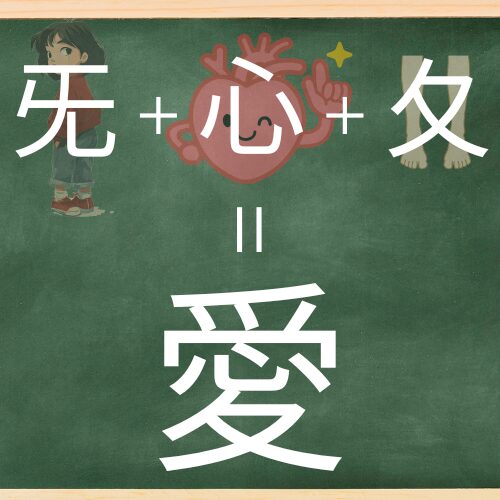
Let me paint you a picture, because the origin of this Kanji is actually kind of poetic (and a little bit haunting).
Imagine a person walking slowly, looking back over their shoulder. Why? Because they can’t bear to leave something behind.
Here is the breakdown of the ancient hieroglyphs:
- The Top: Originally represented a person deeply breathing in or choking with emotion.
- The Middle: This is the MVP—【心】 (Kokoro/Heart). It is literally trapped in the center of the character.
- The Bottom: This represents “legs dragging” or “walking slowly.”
Put it all together? Love is a heart that drags its feet.
It means you care about someone so much that you are reluctant to move on. You keep looking back. It’s not just “happiness”; it implies a heaviness, a reluctance to part ways. It captures that feeling of “I can’t live without this.” How beautiful is that?
5. Culture & Background (The “Vibe”)
In the West, “Love” is everywhere. In Japan? Ai is elusive.
You will rarely hear a Japanese person say “Aishiteru” (I love you) in real life. It’s considered too heavy, too dramatic, almost overwhelming for daily use. Couples usually use “Suki” (I like you) because “Ai” feels like a marriage proposal or a deathbed confession.
The Spirit of Ai:
- It’s Spiritual: In Buddhism, Aizen Myoo is the Wisdom King of Passion.
- It’s Warrior Class: Famous Samurai (like Naoe Kanetsugu) wore this Kanji on their giant helmets. Imagine walking into battle with “LOVE” written in gold on your head. That’s a flex. It meant love for the people and the divine, not romance.
So, when you see this Kanji, don’t think of Valentine’s Day chocolates. Think of a Samurai sword protecting a village. That is the vibe.
6. Vocabulary List (20 Words)
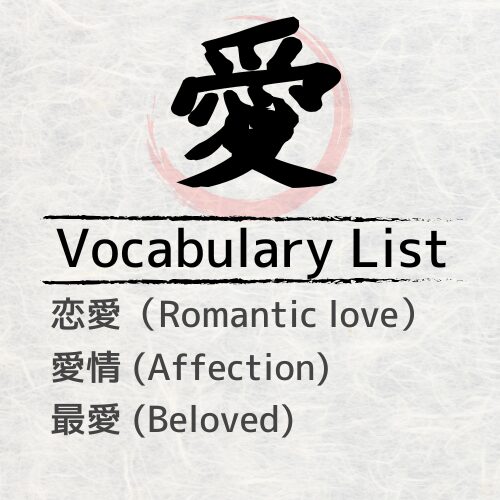
Time to expand your vocabulary. I’ve split this into “Survival Mode” and “Cool Factor.”
Category A: Basic & Useful (The Essentials)
| Kanji | Reading | Meaning |
| 愛 | Ai | Love |
| 愛する | Ai-suru | To love (verb) |
| 愛しい | Itoshii | Beloved / Dear / Darling |
| 恋愛 | Ren-ai | Romantic love / Dating |
| 愛情 | Aijō | Affection / Love (noun) |
| 愛好家 | Aikōka | Enthusiast / Fan (like us!) |
| 愛用 | Aiyō | Favorite (product you use often) |
| 最愛 | Saiai | Beloved / Dearest |
| 愛犬 | Aiken | Pet dog (Beloved dog) |
| 可愛い | Kawaii | Cute (Note: Usually written with diff. Kanji, but derived from 愛!) |
Category B: Cool & Idioms (Anime Moves & Tattoos)
| Kanji | Reading | Meaning |
| 相思相愛 | Sōshi-Sōai | Mutual Love (Two hearts beating as one) |
| 愛嬌 | Aikyō | Charm / Attractiveness |
| 愛妻家 | Aisaika | Devoted husband (Wife-guy) |
| 博愛 | Hakuai | Philanthropy / Universal Love |
| 愛国心 | Aikokushin | Patriotism (Love of country) |
| 溺愛 | Dekiai | doting /doting love |
| 愛弟子 | Manadeshi | Favorite pupil / Star student |
| 無償の愛 | Mushō no Ai | Unconditional Love |
| 敬天愛人 | Keiten Aijin | “Revere Heaven, Love People” (Famous motto) |
| 愛別離苦 | Aibetsuriku | The suffering of being separated from those you love (Buddhism) |
7. In Anime & Manga (Otaku Time!)
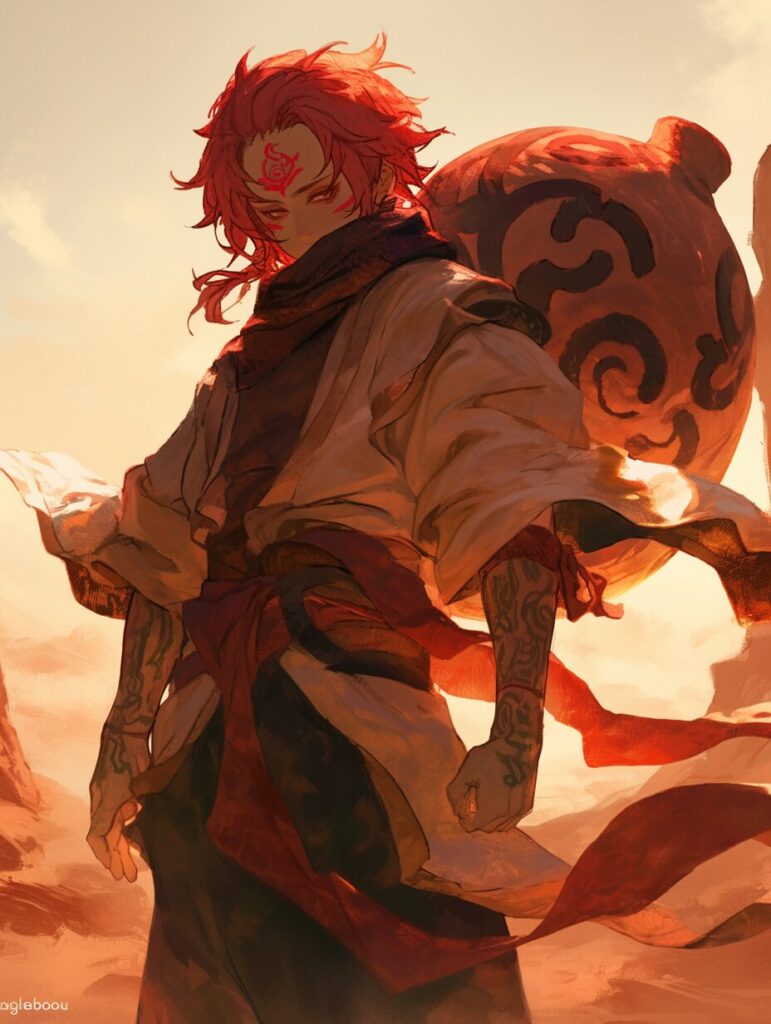
This is the part I was waiting for. Ai is the protagonist of so many character arcs.
1. Gaara (Naruto)
You cannot talk about this Kanji without mentioning the Legend himself. Gaara has the Kanji 【愛】 tattooed on his forehead.
- Why it fits: Initially, it represented “Self-Love” (a demon loving only himself) because he was rejected by the world. But after meeting Naruto, the meaning flips to “Love for friends/village.” It is the greatest redemption arc in anime history, symbolized by a single character on his face. Iconic.
2. Naoe Kanetsugu (Sengoku Basara / History)
If you play Samurai Warriors or watch historical anime, you know the guy with the giant “Love” Kanji on his helmet. That’s Naoe Kanetsugu. He didn’t wear that because he was a romantic. He wore it because he believed in “Ai” for the people and righteousness. Imagine walking into a bloody battlefield with “LOVE” shining in gold on your head. That is a level of confidence I aspire to have.
3. Ai Hoshino (Oshi no Ko)
Her name literally is Ai.
- Why it fits: The entire show deconstructs the concept of “Love” in the idol industry. Is it a lie? Is it real? Her quest to understand what it means to truly love her children drives the entire plot. Her eyes have the stars, but her name holds the weight of the story.
8. FAQ
Q1: What is the difference between “Ai” (愛) and “Koi” (恋)?
A: This is the #1 question!
- Koi (恋): Is passionate, romantic, “I want you” love. It implies a longing. It’s usually for dating.
- Ai (愛): Is deep, unconditional, committed love. It’s what you feel for family, or a partner you’ve been with for 50 years. Koi is the spark; Ai is the fire.
Q2: Can I use “Ai” for food? Like “I love Ramen”?
A: Please don’t. If you say “Ramen wo aishiteru,” people will think you are planning to marry the noodle soup. Use “Daisuki” (Big Like) for food and hobbies.
Q3: Is this a good Kanji for a tattoo?
A: Yes, but be careful. It’s very “strong.” It can look a bit cliché if not done artistically, but because the shape is so balanced and complex, it looks amazing in calligraphy styles. Just know the weight of it before you ink it!
9. Kanji Art Showcase (Artist’s Voice)
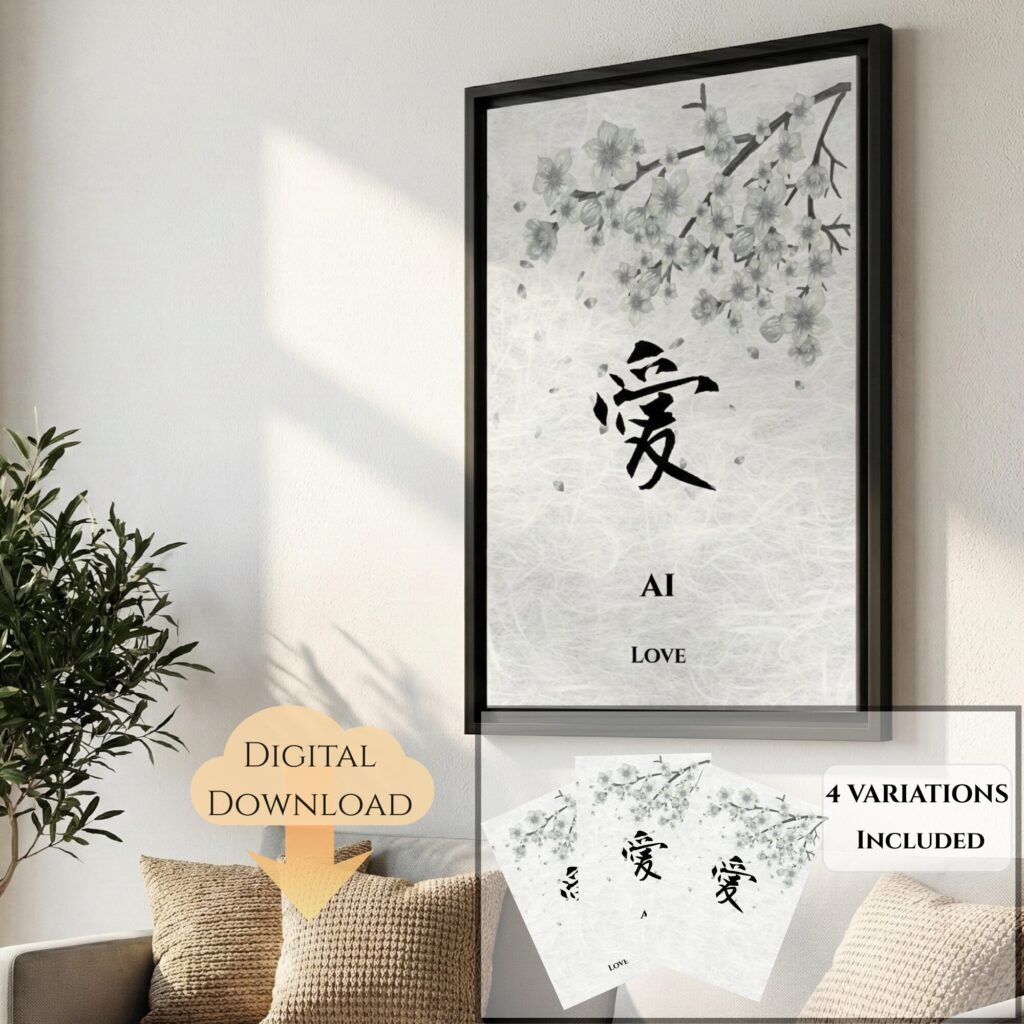
9. Kanji Art Showcase (Design Note)
When I designed this piece for the shop, I was extremely picky about the style.
【愛】 is a tricky character. It has 13 dense strokes, and with the wrong font, it just looks like a black blob. You lose the detail.
I selected a classic, bold typography that perfectly preserves the balance. The key is the Heart (心) in the middle. I wanted to make sure the heart looked protected by the roof above and firmly supported by the legs below.
This style isn’t messy or overly wild; it is clean, strong, and timeless. It represents a “Love” that is stable and unwavering. It’s perfect for a modern aesthetic while respecting the traditional roots.
10. Get This Art
Do you want to bring some of this heavy-hitting, legendary energy into your space?
Whether you’re a Gaara fan, a hopeless romantic, or just someone who appreciates the deep philosophy of Japanese culture, this Kanji belongs on your wall (or your phone wallpaper).
I’ve digitized my hand-written calligraphy of 【愛】 so you can use it for prints, shirts, or just to study.
Grab the digital download here and start spreading the love:
👉 https://www.etsy.com/listing/4352788126/kanji-love-art-print-japanese

コメント